
What Are Fiat Onramps & Offramps – and Why They Power the New Global Economy
Every crypto journey begins and ends with a bridge. Here's how fiat-to-crypto onramp and offramp work, why global coverage matters, and what modern settlement infrastructure looks like.
What Is a Fiat Onramp?
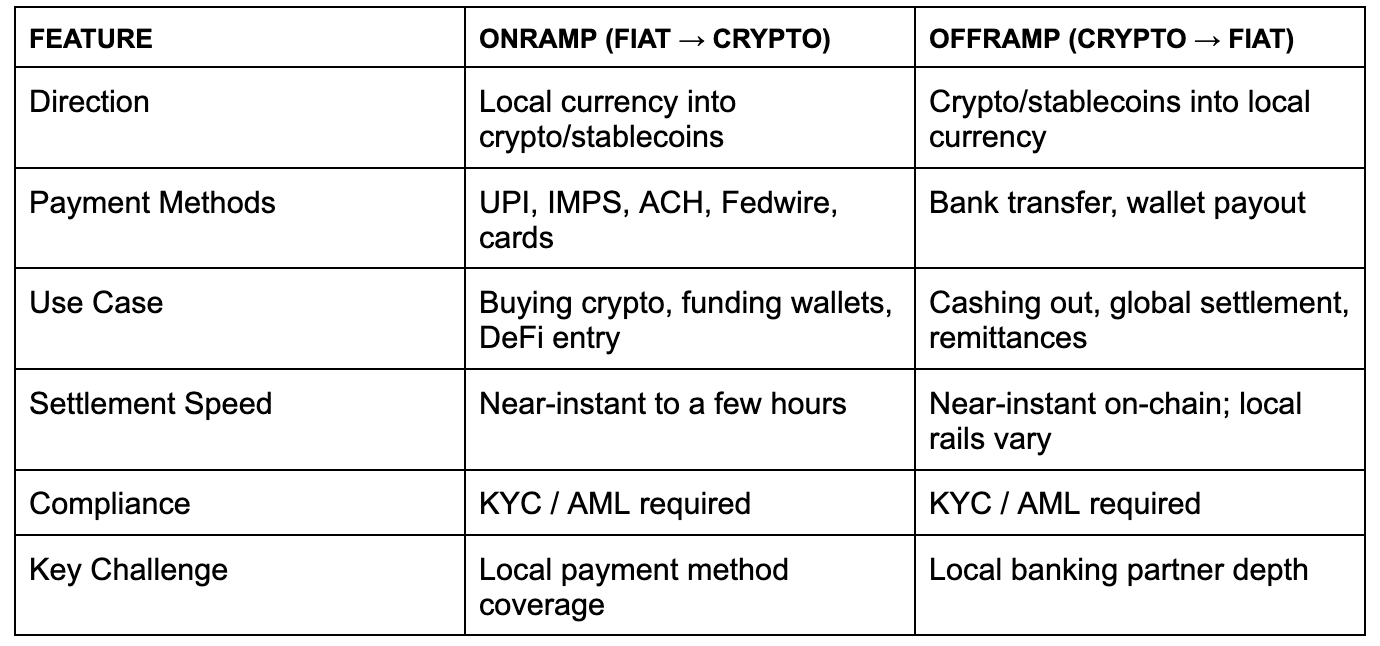
A fiat onramp converts traditional currency (USD, INR, AED) into cryptocurrency or stablecoins. When a user pays in rupees and receives USDT in their wallet, they have used a fiat-to-crypto onramp.
Historically, onramps have been friction-heavy, requiring multiple KYC steps, lengthy processing times, limited local payment options, and high FX spreads. Modern onramp APIs eliminate much of this friction, allowing platforms to integrate quickly and offer users a seamless local payment experience regardless of geography.
What Is a Fiat Offramp?
A fiat offramp does the reverse—it converts cryptocurrency or stablecoins back into local currency and delivers the funds to a bank account.
Together, onramps and offramps create the bridge between traditional finance and the digital asset ecosystem.
Offramps are critical for two reasons:
- They give users confidence that their digital assets are liquid and can be converted into cash when needed.
- They enable businesses to receive funds globally in crypto and settle into local currencies without relying on slow and expensive correspondent banking networks.
Types of Fiat Onramps and Offramps
There are several ways users and businesses can move between fiat and crypto:
- Crypto Exchanges – Offer access to a broad range of digital assets with deep liquidity.
- P2P Platforms – Connect buyers and sellers directly without intermediaries.
- Brokerage Services – Simplify the purchase and sale process for users.
- Payment Processors – Embed crypto payment functionality directly into applications and platforms.
Each model serves different needs depending on transaction size, geography, compliance requirements, and user experience expectations.
Global Settlement: Where Onramps and Offramps Come Together
For businesses, the real value lies in combining onramps and offramps into a unified global settlement infrastructure.
Consider a simple example:
- A user in the United States sends USD via ACH.
- The funds are converted into stablecoins for near-instant cross-border movement.
- An offramp converts those stablecoins into INR.
- The funds are delivered to an Indian bank account through IMPS.
What once took 3–5 business days and incurred significant banking fees can now settle within minutes at a fraction of the cost.
Summary
Fiat onramps convert local currency into cryptocurrency or stablecoins. Fiat offramps convert digital assets back into local currency.
Together, they form the settlement layer connecting traditional finance with the digital asset economy. For businesses operating globally, the quality of this infrastructure directly impacts user experience, operational costs, and the ability to scale across markets.
Carret provides FIU-compliant fiat-to-crypto onramp and offramp infrastructure through a single API, supporting USD, INR, and AED corridors with local payment rails, stablecoin settlement, and real-time transaction visibility. Go live in hours—not weeks.